
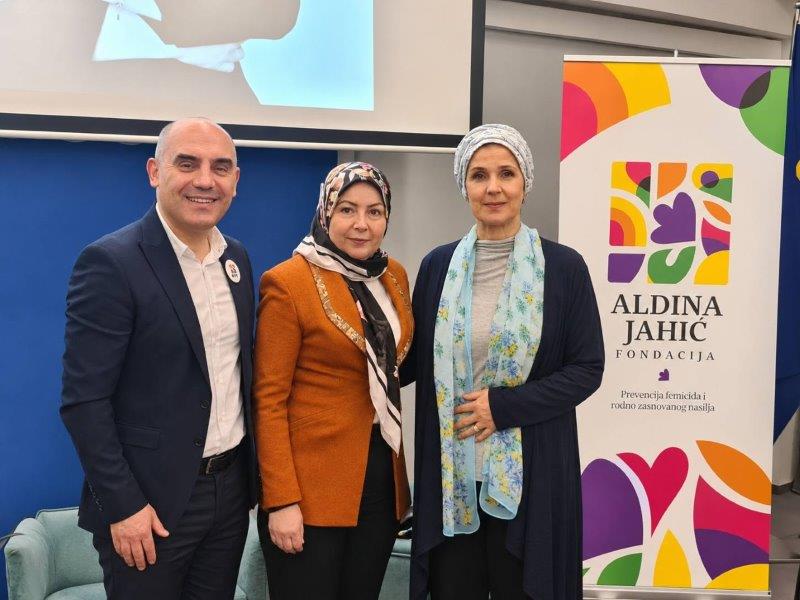
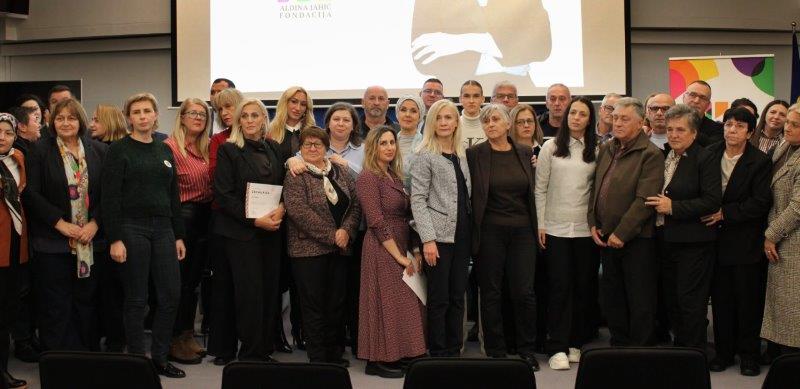
One year after the murder of Aldina Jahić, the question remains the same: How many more women must lose their lives before we begin preventing violence against women rather than merely punishing it? To mark the anniversary of her murder, the Aldina Jahić Foundation organized a panel discussion titled “Where Are We Now and Where Do We Go from Here?” in Sarajevo on November 16, 2026. The discussion focused on achievements to date, institutional failures, and future steps in preventing femicide and protecting women from violence.
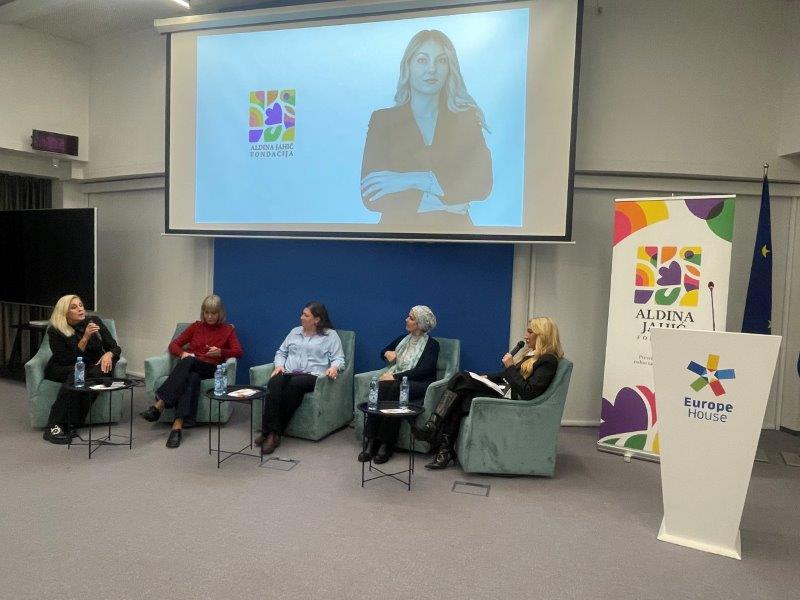
The panel brought together Prof. Dr. Zilka Spahić Šiljak, Director of the TPO Foundation; Dr. Neira Raković, an expert in criminal law; Jasna Zečević from the Vive Žene Association in Tuzla; and Alma Kratina, a member of the House of Representatives of the Parliament of the Federation of Bosnia and Herzegovina. The discussion was moderated by Amra Šehić, a doctoral candidate at the Faculty of Law, University of Tuzla.
What have we, as a society, learned from previous cases of femicide, and why do women remain unsafe despite legislative progress and numerous awareness campaigns? This was one of the central questions raised during the discussion.
Prof. Dr. Zilka Spahić Šiljak reminded participants that the question of how to prevent femicide has been raised for more than twenty years, yet the answer cannot be found solely in harsher penalties or more effective policing and judicial responses. While institutional accountability, timely intervention, and consistent enforcement of laws are essential, it is equally important to challenge the social patterns that enable and justify violence.
She particularly warned against normalized misogyny, toxic models of masculinity, and the deeply rooted practice of victim-blaming, which persists even when women experience the most severe forms of violence. As long as questions are asked about what a woman did, why she did not leave earlier, or why she rejected someone, responsibility is shifted from the perpetrator to the victim. Such a social environment enables violence and makes its prevention more difficult.
In this context, the responsibility of the education system was also emphasized. Preventing femicide does not begin only when violence is reported. It begins much earlier, within families, schools, and everyday relationships, where girls and boys learn the meanings of power, control, respect, consent, and equality. Unless we transform the values and social norms that make violence acceptable, we risk continuously improving mechanisms of punishment while investing too little in preventing future murders.
The panel also addressed achievements in protecting women’s rights, the need for stronger interinstitutional cooperation, consistent implementation of legislation, improved risk assessment, and continuous education and public advocacy against gender-based violence.
Commemorating the anniversary of Aldina Jahić’s murder also served as a reminder that behind femicide statistics are lives lost, futures cut short, and families living with irreparable loss. Remembering Aldina and all other women murdered because of gender-based violence must mean more than holding commemorative events. It must become a commitment by institutions and society to act before it is too late.
The real question is no longer simply how severely a perpetrator will be punished, but what we have done to ensure that the next woman stays alive.