
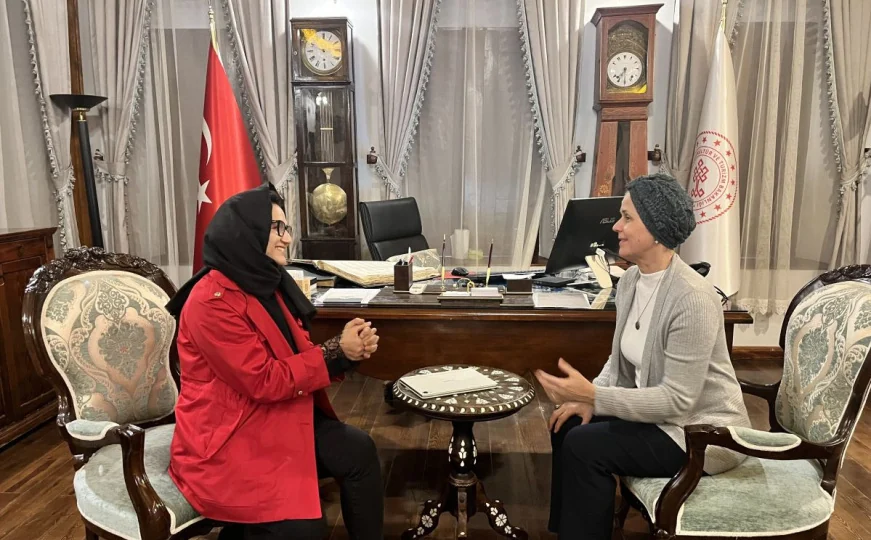
Interview by Dr. Zilka Spahić Šiljak for Radiosarajevo.ba
Dr. Raziye Yılmaz, an artist and university professor from Konya, brings together geometry, art, and Sufi spirituality through Islamic calligraphy. Her work “Ya Hazreti Mevlana” adorns the museum of Mevlana Jalaluddin Rumi, where she created her works in a room overlooking Mevlana’s tomb.
We spoke in the courtyard of the Museum, in surroundings that have inspired spiritual seekers and artists for centuries. For Raziye, calligraphy is not merely the art of beautiful writing, but a path of self-discovery, liberation from the ego, and drawing closer to Divine Love. She spoke about the relationship between tradition and creative freedom, about women who expand the boundaries of Islamic artistic heritage through their artistic voices, and about her own search for Truth.
Radiosarajevo.ba: Who is Raziye Yılmaz? When you introduce yourself, which identities are most important to you?
Yılmaz: Above all, I define myself as a traveler. To me, art is not merely a form of aesthetic expression; it is an inner journey toward myself, toward truth, and toward the essence of creation. On that journey, calligraphy is my language, and the pen is the instrument through which I try to make visible what passes through my heart.
As an artist and academic educated in traditional Turkish arts, my work focuses particularly on ma’kili script and geometric calligraphic compositions. I teach in the Department of Traditional Turkish Arts at the Faculty of Art, Design and Architecture of Karamanoğlu Mehmetbey University. I do not see my teaching, research, and artistic work as separate activities, but as processes that intertwine and enrich one another.
What moves me most in calligraphy is the fact that a single line, seemingly so limited, can open up an infinite world of meaning. A single letter, an empty space, the distance between two lines—all of these can become a distinct field of contemplation.
In Hazreti Mevlana’s explanations, the journey a person undertakes toward their own self resonates with my understanding of art. The journey of the pen is, in a sense, an effort to free oneself of everything superfluous within.
For me, being an artist means not only creating a work of art, but also continually shaping myself anew as that work comes into being.
The Spiritual Meaning of Calligraphy
Radiosarajevo.ba: What does your work, the calligraphic panel “Ya Hazreti Mevlana,” mean to you personally?
Yılmaz: “Ya Hazreti Mevlana” is much more than a name to me; it is an invocation, a prayer, and a turning of the heart. In creating this work, I sought not only to connect letters but also to make visible the love and devotion they carry.
My love for Hazreti Mevlana is not admiration from afar; it is a closeness that calls one to turn inward, question one’s ego, and purify one’s heart. In his thought, at the end of the journey a person begins to know themselves anew. In calligraphy, I search for echoes of that inner journey.
This work holds a special meaning for me. To leave the mark of my own pen in the presence of Hazreti Mevlana, in a place that preserves his spiritual heritage, was a dream I had carried in my heart for years. Its fulfillment is not merely an artistic achievement; it also brings a profound sense of trust and responsibility.
An artist sometimes works on a single piece for years, but there are also works that work within a person for years. “Ya Hazreti Mevlana” is just such a work for me. As I wrote it, my pen was on the paper, but my heart was somewhere else—on the threshold of an encounter with the sacred. In the Sufi tradition, love is not merely a feeling but a force that transforms the human being. In this work, I tried to give form to my love for Hazreti Mevlana. How far I succeeded, I leave to the hearts of those who stand before it.
The Language of Jali Kufic Script
Radiosarajevo.ba: Why did you choose the monumental style of jali Kufic script (celi kufi) for this work?
Yılmaz: For me, jali Kufic is a space in which a line becomes a thought and geometry becomes contemplation. In this script, letters exist not only to be read, but also to shape space, establish order, and create harmony with one another. At the heart of my connection to ma’kili script are the disciplined geometry of this art and the quiet spaces it opens for reflection. The horizontal and vertical movements of the letters, their repetitions, intersections, and the empty spaces between them remind me of the order of the universe. The possibility of creating different forms within a limited system of proportions evokes the relationship between unity and multiplicity in creation.
The monumental character of jali Kufic was especially important for “Ya Hazreti Mevlana.” I wanted Hazreti Mevlana’s name to be expressed not merely as an inscription on a surface, but as an artistic message entering into dialogue with the space in which it is placed. At first glance, geometric order seems mathematical and precise. Yet within that order there is room for intuition, imagination, and contemplation. The rhythm formed by the letters leads the gaze from one point to another, directing the mind toward different layers of meaning.
For me, it is not essential that geometry communicate spiritual meaning directly, but that it offer a person the opportunity to contemplate that meaning. Some things we do not understand through explanations, but by remaining silent before them for a while. It is in that silence that I find part of the strength of jali Kufic script. It is important to know how to be silent so that we can hear and listen to ourselves.
Radiosarajevo.ba: How did studying with the calligrapher Hüseyin Öksüz contribute to your art?
Yılmaz: The discipline of meşk that I learned from the calligrapher Hüseyin Öksüz occupies an exceptionally important place in shaping my understanding of art. In calligraphy, meşk is not simply learning the forms of letters. It is also learning patience, attentiveness, proportion, perseverance, and how to confront one’s own shortcomings. Meşk (Turkish: meşk) is the traditional method of teaching and learning Islamic calligraphy. Yet it is not merely the mastery of calligraphic technique; it is also a process of spiritual and ethical formation of the self.
Writing the same letter again and again may, at first glance, look like repeating exactly the same movement. Yet each repetition is an encounter with a different state of one’s being. Sometimes the letter does not change, but the hand that writes it does; sometimes the line remains the same, but our way of seeing grows deeper.
One of the most valuable things I learned from my teacher is the seriousness and respect with which tradition should be approached. Tradition is not simply the repetition of forms inherited from the past. First one must learn the language of those forms, and then learn to think within it. Beginning from this understanding, I try to connect the tradition I have learned with my own research and artistic endeavors. I see no contradiction between fidelity to tradition and originality.
Radiosarajevo.ba: On the contrary, the more deeply one understands the language of tradition, the more authentically one can find one’s own voice.
Yılmaz: In Sufism, the journey itself is as precious as the destination. Likewise, in calligraphy, the time, patience, and effort invested on the way toward a result are as important as the result itself. To me, taking a pen in my hand means, in part, accepting that I become a student anew every day. For if a person stops at the point where they believe they have learned everything, they cannot grow any further. For me, true learning begins by recognizing my own incompleteness.
Radiosarajevo.ba: What does it mean to you that your work is displayed in such a significant place as the Mevlana Museum?
Yılmaz: The presence of my work in the Mevlana Museum holds a meaning far deeper for me than simply placing a work of art in a particular space. It is the meeting of a dream I nurtured in my heart for years with devoted effort and Divine providence. Konya is a city that preserves the memory of Hazreti Mevlana not only in its historical buildings but also in the hearts of its people. The Mevlana Museum is one of the places where that memory is felt most powerfully.
The opportunity to leave the mark of my pen in such a place awakens deep gratitude and a sense of responsibility within me.
I do not regard the presence of my work there as a matter of personal visibility, but as an emanet—a trust entrusted to my care. When an artist completes and hands over a work, her relationship with it does not end; rather, the work begins to acquire new meanings through the gazes and feelings of others. I believe there is also an important relationship here between tradition and contemporary expression. Calligraphy has survived across centuries in different spaces, with different materials and approaches to composition. Today it is possible to rethink this heritage through the aesthetic language of our time.
My wish is that tradition should not be seen merely as beauty left in the past. Tradition must be capable of speaking to people today and opening space for new questions, new feelings, and new forms of expression. I hope “Ya Hazreti Mevlana” will be a small but sincere part of that dialogue. The fact that a dream I once carried in my heart has now found its place reminds me that art is not merely a matter of work, but also of patience, intention, and Divine providence.
Radiosarajevo.ba: What opportunities and challenges do women encounter in this field, and why is it important to make their contributions visible?
Yılmaz: Throughout history, calligraphy developed within strong traditions of mastery, relationships between teachers and students, and particular artistic circles. Women, too, have left works, invested their labor, and made their contributions within these structures. Yet in art-historical narratives, their names and works have not always been as visible as they deserve. In my view, the problem is not that women are newcomers to this art, but that the existing historical heritage needs to be read more fully.
Research into women’s artworks, their education, their relationships within meşk, and their contributions to the development of this art enables us to understand the history of calligraphy more comprehensively and fairly. Along my own path, I have realized that balancing artistic creation, academic work, teaching, and everyday responsibilities can sometimes be demanding. Yet rather than defining these challenges exclusively as women’s problems, I believe they should also be considered in the context of artists’ working conditions and institutional support. At the same time, we must not overlook the difficulties women may face regarding visibility, representation, and access to opportunities.
It matters to me to create an artistic environment in which women do not feel they must constantly prove themselves in order to have a place in this field. Calligraphy certainly requires effort, discipline, and expertise. But these criteria should be applied equally clearly to everyone. Regardless of whether the artist is a woman or a man, the quality of the work, the depth of the research, and the effort behind it should be valued. Women’s visibility does not mean recognizing individual achievements alone. It also shows young women that they, too, can build a future in this field. It is important to add new names to art history, but equally important to hear voices that were not sufficiently recognized in the past.
From a Sufi perspective, what matters most in a person’s turning toward truth is openness of heart. The doors of art, too, should be open to talent, effort, the desire to learn, and sincerity. The idea of nothingness reminds me that when a person ceases to place themselves at the center, they can create more room for the existence of others.
Radiosarajevo.ba: Do you think the fact that you are a woman influences your approach to calligraphy and its spiritual dimensions?
Yılmaz: I can say that my experience of being a woman is one of the life experiences that shape my approach to art. Still, I would not want to explain it through a distinct style or a predetermined feminine aesthetic. The language of every artist, whether woman or man, is shaped not only by sex and gender but also by education, experience, the intellectual world, and relationships with others. In my art, spiritual sensitivity arises less from a desire to communicate something directly than from an effort to make it possible for something to be felt.
I am drawn to the relationship between script and space, form and meaning, the visible and the invisible. In my ma’kili works in particular, I seek to bring precision together with a space open to interpretation within geometric order. Carrying different responsibilities in life has helped me feel more deeply the value of time and the significance of invested effort. Yet it would not be right to reduce the reflection of that experience in my art exclusively to my identity as a woman. What matters to me is being able to bring what I have lived through into my artistic thinking without turning it into a predetermined pattern.
In Sufism, a person’s inner world acquires meaning through the effort to know and transform oneself. That effort is not limited by whether someone is a woman or a man. Every person has an inner world of their own, and art is born of the relationship between that world and the outer one.
That is why I believe women artists should develop their own voices, but I do not believe those voices must necessarily express a particular tenderness, subtlety, or emotionality. A woman artist can also question, resist, build a geometric and monumental language, and choose between silence and powerful expression. Ultimately, we all carry feminine and masculine characteristics within us; it is a question of our sensibility and openness as to how we express them.
What matters is that, rather than fulfilling gender roles assigned to us from outside, we move closer to our own truth. For me, originality does not mean trying to look different from others, but the ability not to lose our own inner voice amid other people’s expectations.
Radiosarajevo.ba: What needs to change for women artists to gain greater recognition in institutions that preserve Islamic artistic heritage?
Yılmaz: First and foremost, I believe art history should be approached from a more inclusive research perspective. By reexamining archives, museum collections, the lineages of meşk teachers and students, exhibition catalogs, and academic publications, the contributions of women artists can become more visible. It is important that this work not be reduced to remembering women’s names on special occasions, but that it become a natural part of studying art history.
For museums and cultural institutions, it is not enough merely to include works by women artists. They must also develop content presenting these artists’ creative processes, ideas, and understandings of art. Exhibiting a work ensures visibility, but presenting the thought, effort, and story of the woman artist behind it creates lasting cultural memory.
In education, I consider it important to support access to high-quality meşk instruction, contact with masters, workshops, and scholarships. Young artists should not only acquire technical skills but also learn to read art history, conduct research, and ground their own work intellectually. Mentorship is exceptionally valuable in this regard. Experienced artists, women and men alike, should guide young people not only by passing on technical knowledge but also by offering support in facing the challenges of artistic life and forging their own paths. Such support is valuable for all young artists, women and men, and is especially significant for strengthening women’s representation and equal opportunities.
I do not see the authority of tradition merely as permission inherited from the past, but as a heritage built upon knowledge, effort, and responsibility. Mastery requires preserving tradition, but preserving it does not mean confining it to an unchanging pattern. Keeping tradition alive means understanding its essence and passing it on to new generations. For future women calligraphers to find their rightful place, it is not enough simply to open the door to them. The works they create after walking through that door must be fairly valued. Genuine equality means not only the possibility of entering a field, but also the appropriate recognition of one’s work and expertise within it.
I see the future of art in a balance between respect for the masters of the past and the possibilities we offer artists today. Fidelity to tradition and the courage to undertake new creative endeavors should not exclude one another; on the contrary, they should enrich each other.
Radiosarajevo.ba: What would you say to a young woman who is drawn to calligraphy but feels that this tradition is difficult to enter or is dominated by men?
Yılmaz: First of all, I would tell her this: standing at the threshold of an art does not mean that you cannot pass through that door. Sometimes what holds a person back most is not the path itself, but the time spent questioning whether that path is open to them at all.
Calligraphy is not an easy path. It requires patience, repetition, attentiveness, discipline, and many years of effort. Yet these demands need not be obstacles to development. What matters is remaining open to learning, finding a good environment for meşk, and not measuring your own progress against other people’s journeys.
To write a single letter beautifully, you must first understand it, learn its proportions, recognize its shortcomings, and try again. Life is somewhat similar. Sometimes the line does not turn out as we wish; sometimes a work we have spent months on sends us back to the beginning. But not every return is a loss. Sometimes we come back to the same place with a deeper understanding.
If a young woman believes that she may face certain difficulties because she is a woman, I would not dismiss that possibility, but neither would I accept that those difficulties should determine her future.
I would want her to develop her abilities, learn from masters, research, create, and not hesitate to share what she has made. There is no contradiction between standing behind one’s own work and being humble at the same time.
If I could leave one message behind through my artistic journey, I would not want it to speak only of success. For what art gives to a person is far deeper than any visible result. The pen teaches a person patience, self-questioning, sometimes silence, and the ability to begin anew in spite of everything.
In the thought of Hazreti Mevlana, a person’s journey finds meaning through the search for Truth within. I believe art can be a companion in that search. The pen is an instrument in a person’s hand, but over time it can become a fellow traveler that helps them know themselves.
Finally, I would say to a young woman: do not define yourself in someone else’s shadow, but do not overlook the traces of those who walked before you. Learn from masters, respect tradition, and search for your own voice. For when you find your own voice, you can be original without having to abandon tradition. To me, the deepest secret of calligraphy lies in the quiet space that opens between lines. Sometimes empty space carries as much meaning as the letter itself. What we understand in Sufism as nothingness is not destruction, but an awareness of a greater meaning through diminishing the demands of one’s own ego.
Perhaps that is the essence of my entire journey: while I try to leave a trace with my pen, to make myself a little smaller; while multiplying lines, to diminish my ego; while completing a work, to remain aware that my inner search is not yet finished.
For I see art equally as walking and arriving, as silence and writing, as listening to the invisible and as being seen. And I believe that, as long as the human heart remains open to truth, every new work is a new threshold opening before it.
Source: Radiosarajevo.ba, “Intervju | Raziye Yilmaz: Mevlana – putovanje prema Sebi perom kaligrafije,” https://radiosarajevo.ba/metromahala/teme/intervju-raziye-yilmaz-mevlana-kaligrafija/661688