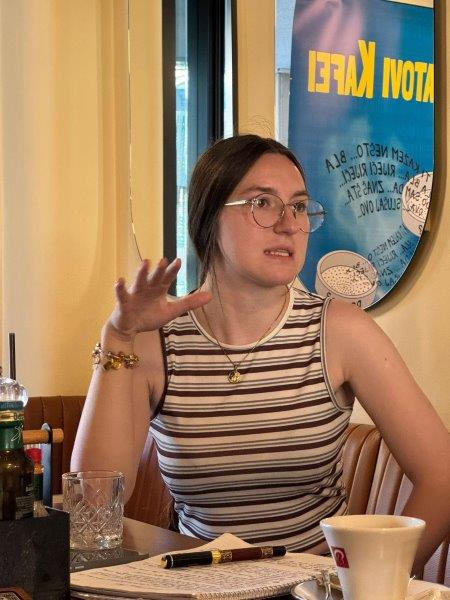













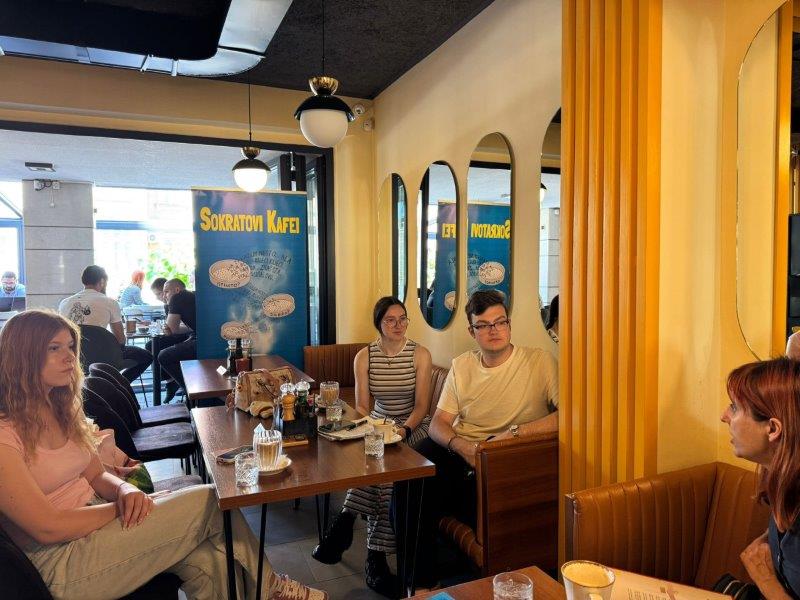
On June 8, 2026, a Socrates Café was held in Tuzla, dedicated to the question: “Is it possible to live ethically in a consumer society?” The conversation with Prof. Dr. Selma Veseljević Jerković was moderated by Ernada Avdibegović, opening a space for reflection on everyday choices, individual responsibility, the power of systems, and the challenges of living in a contemporary capitalist and consumerist society.
The participants discussed the extent to which consumer culture shapes our desires, needs, habits, and values. In a society where success is often measured by the amount one owns, the purchase of new products, following trends, and visibility on social media, ethical living becomes a complex question. Do we truly choose freely, or are our decisions already shaped in advance by advertising, the market, algorithms, social pressures, and the constant production of new needs?
A special part of the conversation was dedicated to the influence of media and social networks. The participants pointed out that media and digital platforms strongly shape contemporary trends, as well as our understanding of success, beauty, happiness, and the “good life.” Social networks often intensify the pressure to constantly keep up, to own, display, and compare oneself with others. At the same time, they can also be spaces for information, education, solidarity, and raising awareness about ethical consumption, ecology, workers’ rights, and sustainable ways of living.
One of the key questions that emerged was the question of responsibility. The fact is that each of us can take certain steps: consume more responsibly, reduce unnecessary consumption, repair and share things, support local producers, avoid food waste, care for the environment, and critically reflect on our own habits. In this sense, we all carry a part of the responsibility for the world in which we live.
However, the participants emphasized that responsibility is often placed too heavily on individuals or self-organized groups, while the responsibility of the system is discussed far less. This raises the question of what role is played by local communities, states, educational institutions, companies, international organizations, and the global economic order. Can an individual live fully ethically if the system simultaneously encourages unsustainable production, inequality, labor exploitation, and constant consumption?
In the end, the question remains for all of us: is it possible to live ethically in a consumer society, and what are we willing to change in order to make such a life possible?