













Does religion restrict women, or are restrictions often the result of how religion is interpreted? Who decides what constitutes a religious obligation and what is merely a social custom? And why are certain norms, especially those concerning women, presented as unchangeable divine commandments, even though they emerged within specific historical and cultural circumstances?
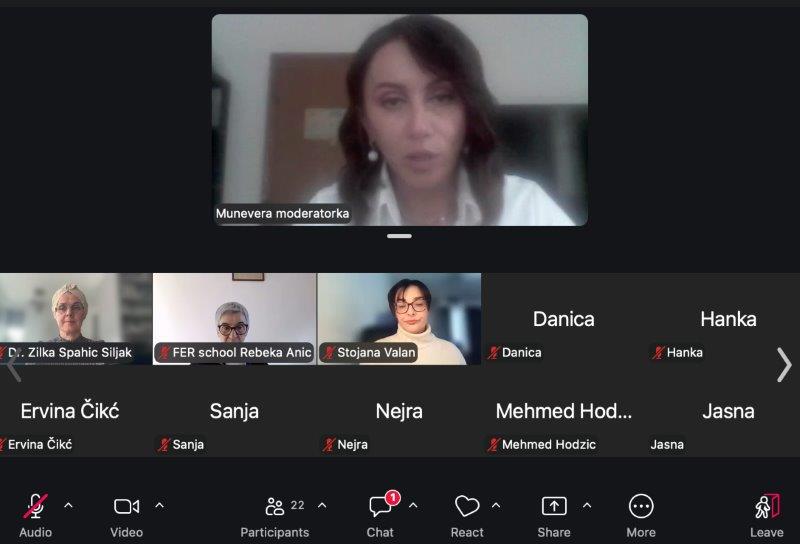
These questions were at the heart of the online webinar “Faith Says, Society Says,” held on October 26, 2026, and organized by IKRE, an NGO based in Rožaje, Montenegro. The webinar featured Prof. Dr. Zilka Spahić Šiljak, Professor of Gender and Religious Studies and Director of the TPO Foundation.
In her presentation, Professor Spahić Šiljak highlighted the importance of critically engaging with religious texts and distinguishing between what the Qur’an actually says, what interpreters have said throughout the centuries, and what is presented as a religious norm in everyday life.
She devoted particular attention to gender equality within the Islamic tradition, emphasizing that interpretations of sacred texts have always emerged within specific social and historical contexts. Patriarchal societies have shaped dominant interpretations of relations between men and women, often presenting social hierarchies as part of a natural and divinely ordained order.
One of the examples she discussed was the Qur’anic verse An-Nisa (4:34), which has been used for centuries in discussions of male authority within the family. Professor Spahić Šiljak stressed the need to distinguish the Qur’anic text itself from its classical interpretations, including those that attribute a superior position to men and grant them authority over women’s behavior. Such interpretations must be understood within their historical contexts while also being critically examined in terms of their consequences for women’s dignity, freedom, and safety today.
In contrast to hierarchical interpretations, she drew attention to the Qur’anic verse Al-Ahzab (33:35), in which women and men are explicitly and equally recognized as morally responsible human beings. Particularly significant is the fact that classical exegetical traditions connect the circumstances of this verse’s revelation to questions raised by women who sought to be explicitly mentioned in the Revelation. This opens an important space for understanding women as active participants in the early Muslim community who asked questions and demanded recognition of their voices.
An important part of the presentation focused on the regulation of women’s bodies, clothing, and behavior. Professor Spahić Šiljak questioned the boundary between protection and the restriction of freedom, particularly when religious arguments are used to impose norms on women that are not equally applied to men.
At the same time, she warned against the prejudice and discrimination experienced by women who wear the hijab. Freedom of religion includes both a woman’s right to wear the hijab and her right to make her own decisions about her body and clothing, free from coercion, stigmatization, or social exclusion.
In this context, she emphasized the importance of education and the development of critical religious literacy. Invoking the authority of tradition is not sufficient without asking who formulated a particular norm, under what circumstances, for what purpose, and what consequences it produces today.
The key question is not only what religion says, but also who speaks in the name of religion, whose voice is considered authoritative, and why women’s voices have so often been marginalized in the process of religious interpretation.
The webinar “Faith Says, Society Says” provided a space for reflection on the relationship between religion, culture, and gender norms, while highlighting the importance of dialogue that embraces critical thinking. Distinguishing religious teachings from patriarchal customs does not mean rejecting religious tradition. Rather, it creates an opportunity to understand and apply its ethical principles of justice, compassion, and human dignity in contemporary society.
