





















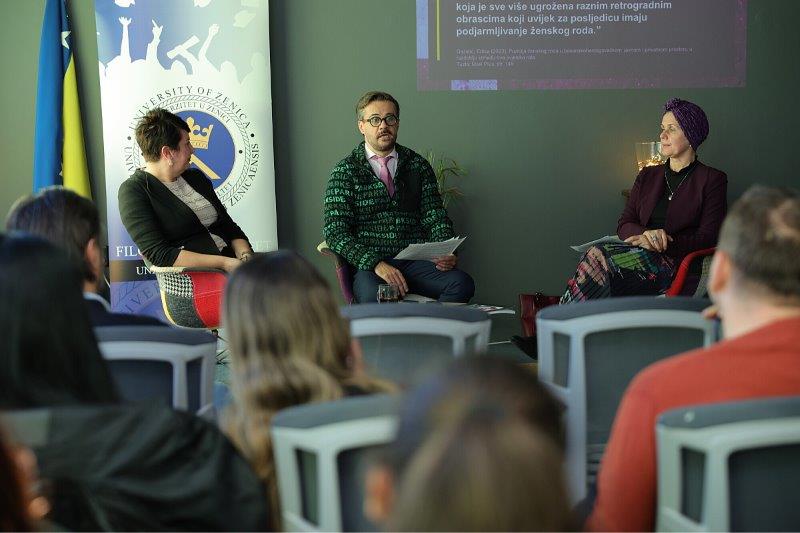
Literature is not merely a mirror of society but also a space in which social norms, power relations, and gender hierarchies are constructed, reinforced, and challenged. These questions were at the heart of the promotion of two books by prof. dr. Edisa Gazetić, held on October 27, 2026, at the Faculty of Philosophy of the University of Zenica, as part of the 2nd Sexual Theatre Festival. Although both books were published in 2023, this was their first joint promotion. Alongside the author, prof. dr. Zilka Spahić Šiljak discussed the books, while the conversation was moderated by prof. dr. Hazim Begagić.
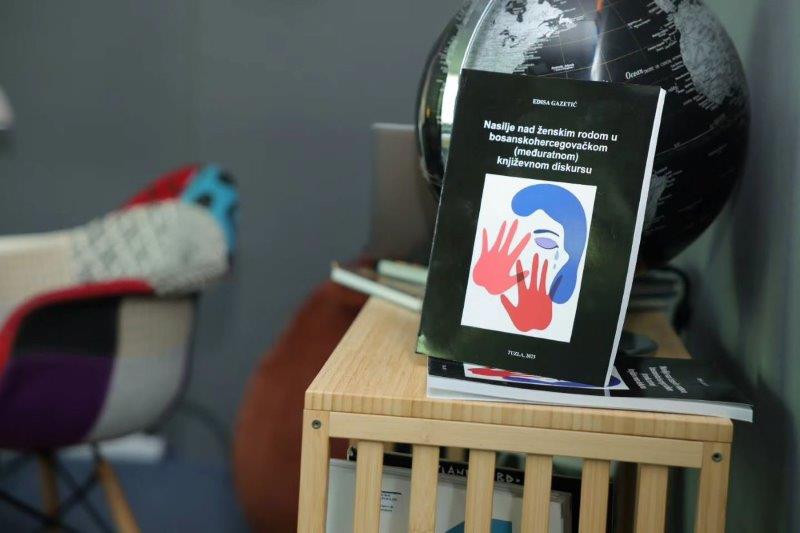
Drawing on feminist literary theory, prof. dr. Gazetić examines the position of women in Bosnian-Herzegovinian society between the two world wars, analyzing how female characters were represented in literary texts, as well as the social circumstances that shaped women's opportunities for participation and agency in the public and private spheres.
The book The Position of Women in the Public and Private Spheres of Bosnia and Herzegovina Between the Two World Wars explores questions of social expectations, restrictions, and opportunities for women's emancipation during the interwar period. Particular attention is devoted to the relationship between the private and public spheres, especially the ways in which gender norms shaped women's everyday lives, education, social participation, and autonomy.
In Violence Against Women in Bosnian-Herzegovinian (Interwar) Literary Discourse, the author focuses on various forms of violence against women and their representation in literature. A feminist reading makes it possible to understand violence not merely as an individual act but also as a consequence of broader patriarchal structures, social norms, and unequal power relations. The promotion also raised questions about the contemporary relevance of these studies. Although the literary works analyzed belong to the period between the two world wars, stereotypes about women, control over women's bodies, the division between public and private spheres, and various forms of gender-based violence remain important issues in contemporary society.
Feminist literary analysis is therefore not simply a rereading of the past but also a critical examination of the present. It enables us to recognize how gender inequalities are normalized through language, literary narratives, and cultural patterns, and how these patterns are transmitted from one generation to another.
The book promotion highlighted the importance of interdisciplinary connections between literature, history, sociology, and feminist theory in understanding the position of women. prof. dr. Gazetić's books contribute to opening up new perspectives on Bosnia and Herzegovina's literary heritage and encouraging critical reflection on the relationship between gender, culture, and social power.
